Engineering the surface chemistry of silicon nanocrystals for efficient Ag-Si hybrid photocatalysts toward CO2 reduction
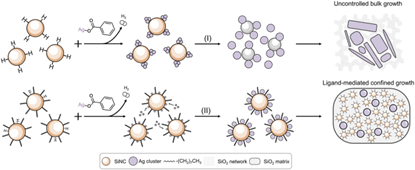
Abstract: Plasmonic nanoparticles (NPs) enable exceptional light harvesting via localized surface plasmon resonances (LSPR), yet their photocatalytic utility is limited by ultrafast charge recombination and surface contamination from synthesis. Here, we overcome these challenges by applying the surface chemistry of silicon nanocrystals (SiNCs) to synthesize hybrid nanostructures of uncoated silver nanoparticles (AgNPs). The alkyl-passivated SiNC surface acts as a reductive template, guiding the in-situ formation of clean, interfacially coupled AgNPs while protecting the SiNC core from oxidation. This tailored architecture leverages a synegiestic mechanism to enhance AgNP plasmon resonance, drive efficient hot-electron transfer and improve charge carrier separation. The resulting Ag@SiNC hybrid achieves improved CO2 reduction performance, with a CO yield of 1,552 μmol/g and near 100% selectivity under visible light irradiation. This work establishes surface-engineered SiNCs as a versatile platform for designing high-performance plasmonic–semiconductor photocatalysts.
Paper Link: https://doi.org/10.3389/fchem.2026.1799409