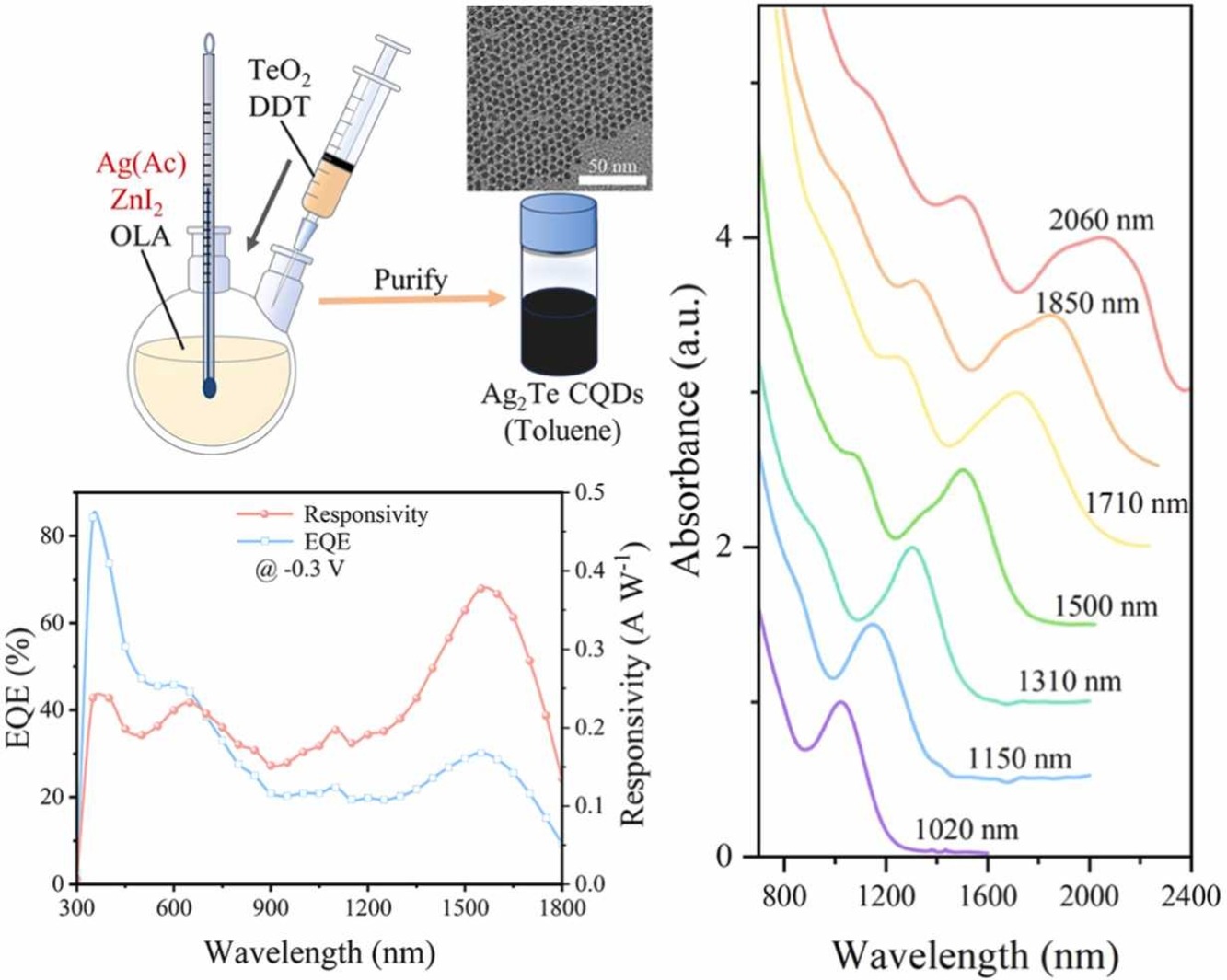
Zinc halide enables highly monodisperse Ag2Te colloidal quantum dots for short-wave infrared photodetectors
Abstract: A novel zinc halide-controlled synthesis method has successfully produced highly monodisperse Ag2Te colloidal quantum dots. By forming silver-halogen complexes to regulate precursor reactivity, this approach enables one-step hot injection synthesis of uniformly sized quantum dots with tunable optical bandgaps. The strategy not only simplifies the process but also significantly enhances surface passivation, effectively reducing defect states. The resulting short-wave infrared photodetectors demonstrate excellent overall performance at 1550 nm, featuring high responsivity and external quantum efficiency while maintaining low noise levels and good operational stability. This advancement provides a new technical pathway for developing environmentally friendly, high-performance infrared detection materials.
Paper Link: https://doi.org/10.1016/j.nanoen.2025.111026