Modulating the Surface and Optical Properties of Hydride-Terminated Silicane through Thermal Alkoxylation
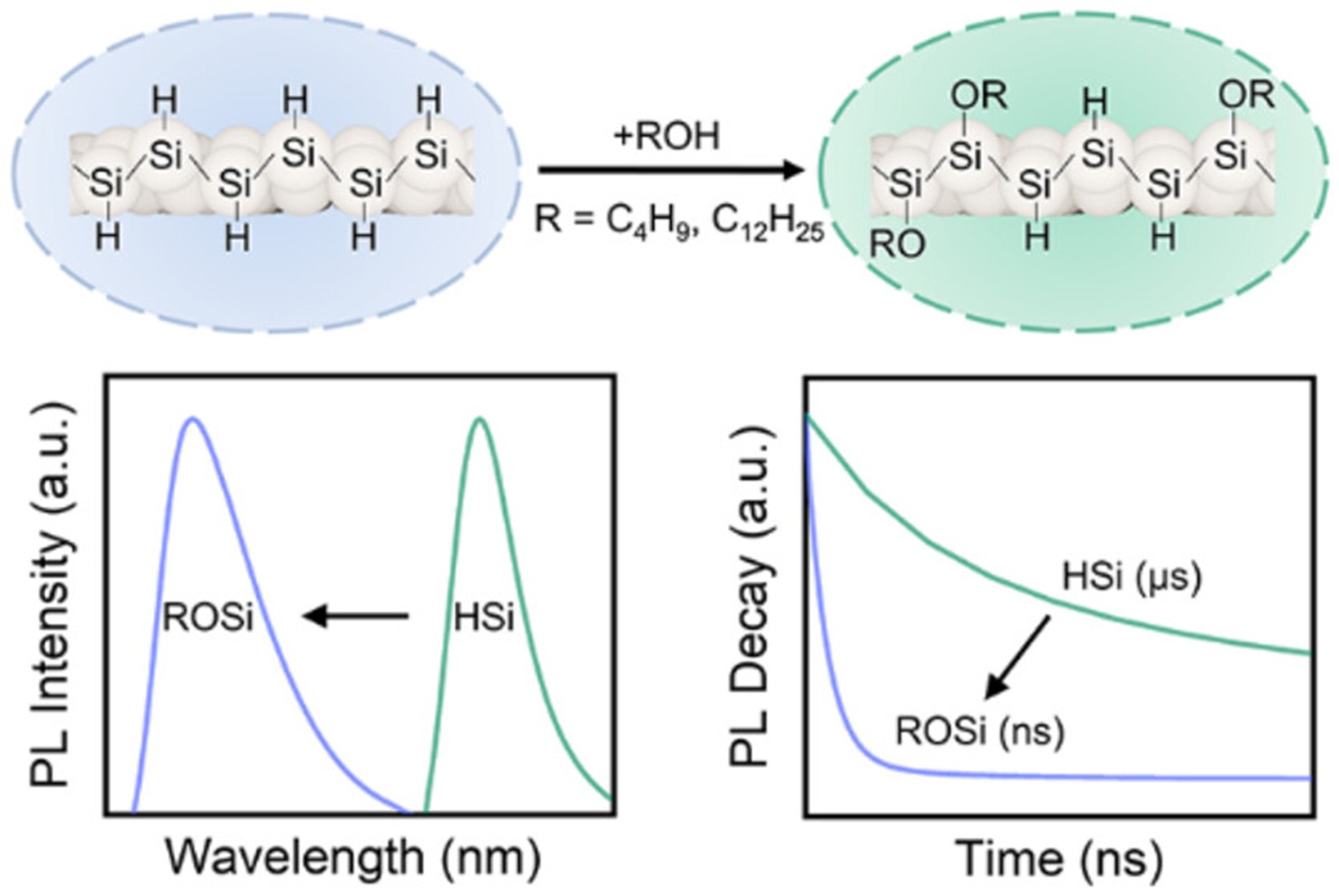
Abstract: The surface modification of hydride-terminated silicane (HSi) via thermal alkoxylation is experimentally demonstrated for the first time. Using two types of alcohol (butanol and dodecanol), alkoxyl groups are successfully grafted onto HSi through a mild thermal process, preserving the two-dimensional (2D) structure of HSi. Spectroscopic characterization confirms the formation of Si–O linkages, and electron microscopy reveals intact morphologies of alkoxylized silicane. These alkoxylated silicanes exhibit a distinct blue shift in photoluminescence (PL) emission and significantly faster PL decays compared to those of pristine HSi. Temperature-dependent PL measurements and density functional theory calculations reveal that the green emission of HSi arises from radiative recombination at an indirect band gap, whereas the blue emission of alkoxy-terminated silicane originates from surface trap states introduced by alkoxylation.
Paper Link: https://doi.org/10.1021/acs.jpcc.5c03083