Enhancing charge carrier mobilities in colloidal germanium quantum dot solids via solid-state ligand exchange
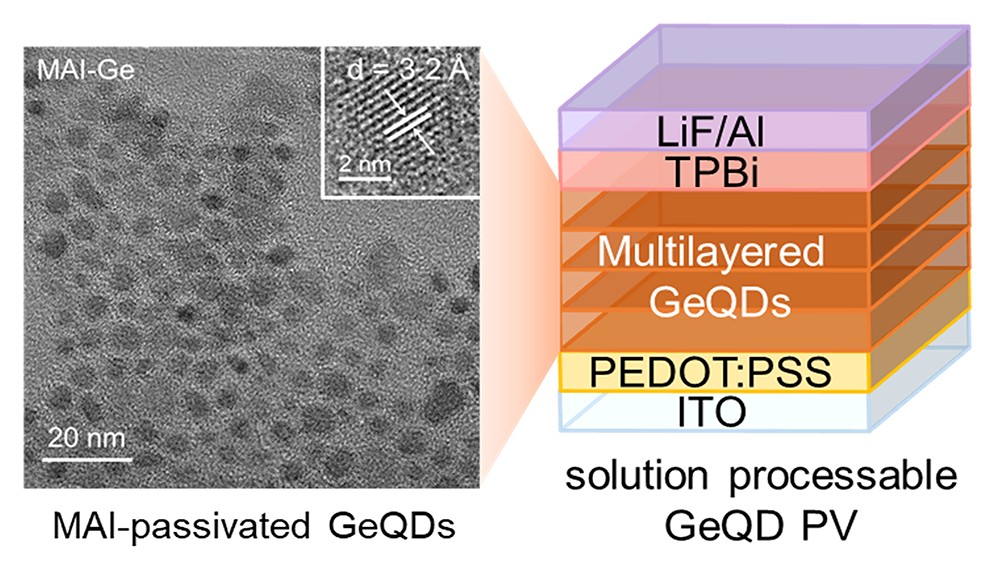
Abstract: The optoelectronic tunability and solution processability of colloidal germanium quantum dots (GeQDs) make them highly attractive as active materials for thin film optoelectronics. However, while long-chain aliphatic ligands can effectively protect GeQD surfaces from oxidation and enhance colloidal stability, their insulating nature severely impedes charge carrier transport within the GeQD active layer. In this study, we introduce a solid-state ligand exchange (SSLE) approach using methylammonium iodide (MAI) to replace the insulating oleylamine ligands, thereby enhancing charge carrier mobilities in the GeQD thin film. We demonstrate that a low concentration of MAI effectively substitutes OAm on GeQD surfaces while preserving the structural integrity of the crystalline core. The resulting MAI-passivated GeQD films exhibit significantly reduced trap densities and enhanced hole and electron mobilities compared to their OAm-passivated counterparts. Furthermore, we fabricate solar cells using a layer-by-layer SSLE process to construct a multilayered GeQD active layer, achieving a power conversion efficiency of up to 1.64 × 10⁻³ %, a significant improvement over previously reported GeQD photovoltaics.
Paper Link: https://doi.org/10.1021/acsaelm.5c00777