Revisiting the Influence of Surface Alkoxylation on Colloidal Silicon Nanocrystals
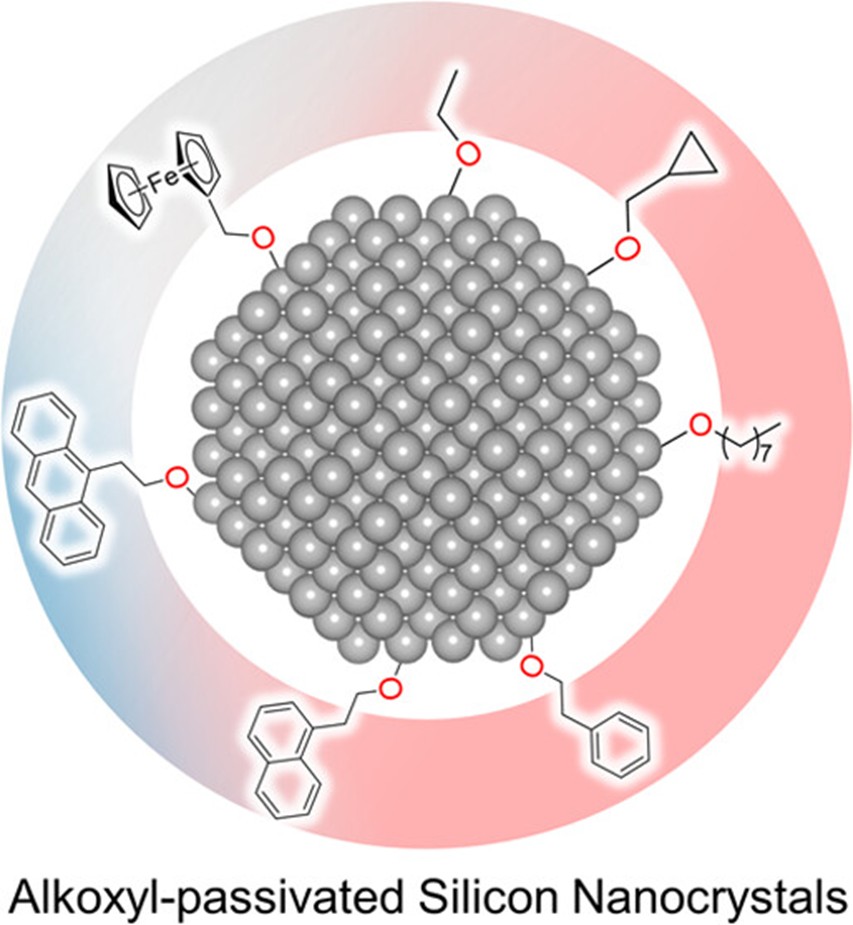
Abstract: Colloidal silicon nanocrystals (SiNCs) exhibit promise for applications in optoelectronics and bionanotechnology, attributed to their distinct surface-tunable photoluminescence (PL) and photophysical characteristics. Alkoxylation has aroused interest as a functionalization methodology for the efficient construction of Si–O bonds on the surfaces of SiNCs under mild conditions. However, there exist different opinions on the influence of surface alkoxylation on the photophysical properties of colloidal SiNCs. Herein, we conduct a systematic comparison between hydrosilylation and alkoxylation on SiNC surfaces to explore the impact of alkoxyl-based ligands on the photophysical properties of SiNCs. The alkoxylated SiNCs exhibit a similar particle size and efficient surface ligand modification compared with their hydrosilylated counterparts. Consistent steady-state spectra and transient absorption results indicate that alkoxyl-passivated SiNCs do not change the SiNC-core-related electron–hole recombination dynamics or charge transfer between the SiNC core and the surface-modified ligands compared with the conventional alkyl-functionalized particles. We further demonstrated the application of alkoxylation to the functionalization of SiNCs with ligands that cannot be easily anchored on surfaces via conventional hydrosilylation approaches.
Paper Link: https://doi.org/10.1021/acsphotonics.4c00335