Nucleophilic Attack Enables Crystalline Silicon Formation Through Dehydrocoupling at Room Temperature
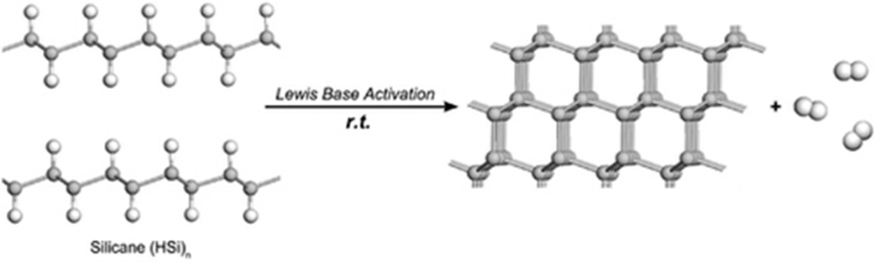
Abstract: Crystalline silicon (c-Si) has been widely used in semiconductor and energy-related industries. A significant challenge in c-Si production is the requirement for high temperatures or highly reactive precursors to promote Si–Si bond formation. Herein, we demonstrate a new process for preparing c-Si directly from hydride-terminated silicane (HSi) under mild conditions. We design a dehydrocoupling approach that effectively creates Si–Si bonds between HSi flakes via nucleophilic attack by Lewis base reagent at room temperature. c-Si produced through this wet-chemistry process demonstrates promising capabilities in charge carrier migration and separation under visible light irradiation. Compared to all the existing c-Si manufacturing processes, the reported approach drastically reduces the required reaction temperature and provides a new strategy to tailor the electronic and photophysical properties of c-Si for optoelectronic and catalytic applications.
Paper Link: https://doi.org/10.31635/ccschem.024.202405067